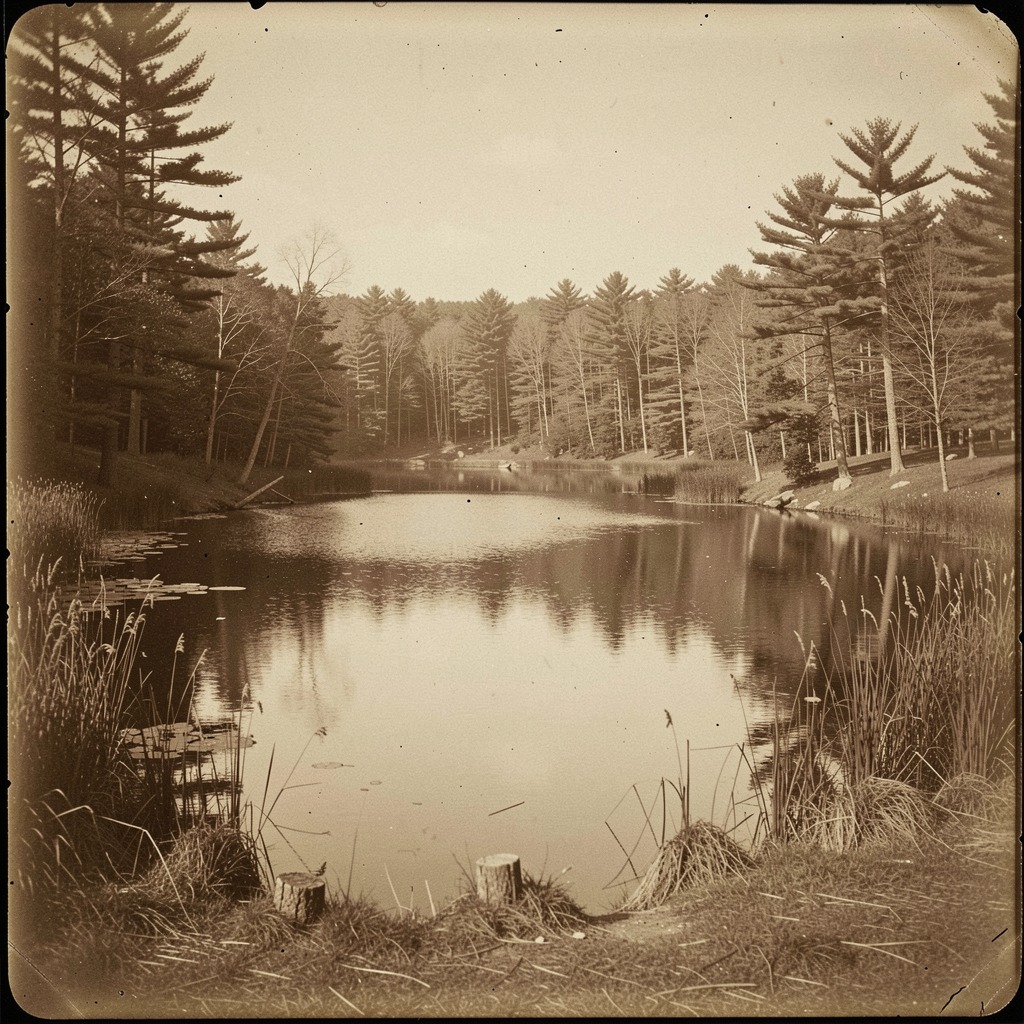
WILLOW CREEK — The deep, spring-fed kettle pond that sits beside the mill race — known to generations of Willow Creek residents simply as “the pond” or, more specifically, “the deep hole” — has acquired a name.
In a feature article published in this week’s Gazette, I have referred to the body of water as “Homan’s Pond,” after the family that has owned the land surrounding it since 1869. To the best of my knowledge, this is the first time the name has appeared in print.
The pond — let us call it Homan’s Pond, for the sake of clarity — has been the site of the Willow Creek Ice-Out competition for eight years now. It is a distinctive body of water: roughly four acres in surface area, spring-fed, and unusually deep for a Maine kettle pond. Soundings taken by the mill company in 1900, when the dam was built, recorded a maximum depth of 38 feet.
Elias Homan, who inherited the property from his father Silas in 1920, has permitted the Ice-Out to be held on his land without compensation since the competition’s inception. He has refused offers of payment from the organizers.
“I did not create the pond,” Homan told me when I visited his farm this week. “God put it here. I just happen to live beside it. The Ice-Out brings the town together in the worst part of the year. Why would I charge for that?”
The name “Homan’s Pond” is not official in any legal sense. The town’s maps refer to the body of water as “Pond No. 7” — a designation assigned by the county surveyor in 1847 that appears in no document since. The state’s geographic board has no record of an official name.
But names, in a small town, are not conferred by maps. They are conferred by use. And the use in Willow Creek has, for several years now, been trending toward “Homan’s Pond.”
I put the question to Ezra Homan, Elias’s son and the man who keeps the Ice-Out’s spiral notebook of pond conditions, whether the name pleased him.
“It is my family’s name,” he said. “Of course it pleases me. But the pond belongs to everyone who watches it. If the town wants to call it Homan’s Pond, I will not argue. If they want to call it something else, I will not argue either. The pond does not care what we call it. It just sits there and freezes and thaws, year after year.”
That, it seems to me, is a sentiment worthy of a name.
Related stories
- Ezra Thorne II Objects to Pond Naming at Heated Town Meeting
- Mill Workers Turn Winter Standstill Into a Wager on the Spring Thaw
- Homan and Thorne Face Off in Water Rights Suit